
Real Milk Updates, Spring 2026
May 28, 2026Raw Milk Stories Ignore Studies on Unpasteurized Benefits
October 18, 2026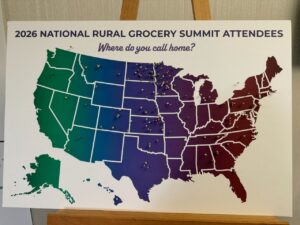
Photo credit: Clara Misenhelter, National Rural Grocery Summit Attendees
The ninth National Rural Grocery Summit, took place May 5-7 in Fargo, North Dakota. The Real Grocery Initiative (RGI) convened the summit. RGI seeks to “enhance community and improve access to healthy foods by identifying, developing and sharing resources that support grocers and rural communities.” The majority of the 300-plus attendees were either affiliated with small independent grocery stores or food cooperatives. The number of small independent grocery stores in the U.S. is declining. With the accelerating decline in quality of the industrial food system, independent grocers and food coops can be an important part of the buildout in the parallel local food system which is essential for attaining optimal health. Increasing markets for regenerative farmers, and building resilient local supply chains are a critical part of this effort.
Speakers at the summit discussed a number of innovative approaches to growing the local food economy. One innovator is the retailing operation, Argus Farm Stop in Ann Arbor, Michigan; some 300 farmers and local artisans sell their products on a consignment basis at Argus, receiving 70% of the retail price. Farmers stock the store shelves, determine what products should be on the shelves and the price for each product. The store’s general policy is not to have more than three vendors selling a particular product. The store’s main mission is to grow the local food economy rather than maximize profits; it derives most of its revenue from a café it operates in the same building.
The farmers are responsible for labeling and packaging their products; the farm store is responsible for barcoding. There is no agreement between the farm store and the farmers on the latter’s pricing at other sales venues; the farmers are free to sell at lower prices. Before they can sell at Argus, farmers must submit an application to the store. The store determines whether there is strong enough consumer demand for the product and whether the farmer applicant has enough product to meet that demand. Once they start selling at the store, farmers receive sales reports every two weeks from management.
In 2024, the farm store did $7 million in sales; the top 75 farms average $44,000 in revenues. Over half of Argus’s sales are produce. A number of growers selling to it have put up hoop houses to extend their growing season. Some of the leftover product from Argus goes to food pantries. The farm store model looks to be catching on. There are now 30 farm stores like Argus in the U.S. The last few years, Argus has held a farm conference in Ann Arbor.
Another retail food business providing a sizable market for farmers that presented at the conference was the Hanover Food Cooperative, which consists of three stores: Hanover, New Hampshire; Lebanon, New Hampshire, and White River Junction, Vermont. The co-op sources 4,000 products from 400 local and regional vendors. Its bottom line is not profit, but whether it is serving the community. Last year the co-op stores generated $99 million in sales; its net was $200,000. For decades, the co-op has held an annual growers meeting to collaborate and figure out what to produce and how much each grower would be selling to the store. The co-op forward contracts with growers [i.e., enters buying agreements before the growing season begins]; if a grower is short on a crop, other growers selling to the co-op step into help. The co-op lowers its margin and buys less commodity crops when local produce is in season. The co-op also commits to a yearly schedule with meat producers and saves the producer time and resources by picking up the producer’s meat directly from the processor. The co-op prioritizes local producers over regional ones. It has served as an incubator for many food businesses; it was Stonyfield Farms’ first customer when that business started up in 1983.
A food cooperative that has been successful in strengthening local food supply chains has been the Manna Cooperative in Detroit Lakes, Minnesota. The co-op initially started in an abandoned Tasty Freeze shop. Today it resides in a brand new 6,000-square-foot building that opened earlier this year. It sources from over 40 vendors located within 100 miles of its store. Its building includes a commercial kitchen that serves as an incubator for food entrepreneurs. Many of the entrepreneurs renting the kitchen space sell their products in the front of the store. The commercial kitchen is also used to produce food distributed through farm-to-school programs and food pantries.
A major focus of the co-op is on producing food entrepreneurs. It provides an eight-week training course for producers on becoming “retail ready” through education on marketing, licensing, cost of ingredients and other topics. It honors a producer of the week. It partners with producers on selling locally sourced meal kits and holds pop-up events such as community dinners with food from local farms. It features local producers in the store, selling direct to their customers.
Much of Manna’s services is based on making local supply chains more resilient. There are major challenges the independent rural grocers is facing; one of them is competition from the wealth extractors, namely among them Walmart and Dollar General. One grocery store owner from eastern Montana spoke about how he lost business to a Walmart ninety miles away because residents of his town would do a one-stop shop at the Walmart to stock up on groceries and other items. Another grocery store owner whose business was located in a Minnesota town with an official population of ten spoke about how some of the townspeople stopped an attempt by Dollar General to build a store. Interestingly, the manager of an independent supermarket in Pelican Rapids, Minnesota, said that he believed the presence of Dollar General in his town discouraged Walmart from setting up shop there. He said Dollar General costs the supermarket sales of canned foods, but a nearby Walmart could have cost sales of meat, poultry, eggs and dairy. Recently, some Dollar General stores have started selling produce.
Another problem the independent grocer has to deal with is lack of enforcement of the Robinson-Patman Act, a New Deal era federal law that prohibits suppliers from discriminating in favor of chain stores; the retail giants strong-arm suppliers to wring favorable concessions that small buyers don’t get. Louisiana Governor Hughey Long said that he would rather have thieves and gangsters in his state than chain stores.
Another obstacle for the rural grocer is labor shortages. One grocery owner at the summit spoke about dealing with that issue by working with a flexible labor schedule so some employees might work as little as once a week or even once a month. To incentivize workers, one store had an employee Hall of Fame where management posted pictures of hall members in the store. Main Street Market in Evansville, Minnesota, (population 632) operates a self-service grocery store for members 24/7; the market worked out a deal with the state of Minnesota, whose law requires a certified food manager to be on site when the store is open. Patrons can join under 3-, 6- and 12-month memberships; members can use the phone app to open the door, scan grocery items and pay. The store runs on the honor system but does have video cameras just in case.
Choice of wholesale distributors for the grocers is another issue. Two national wholesale distributors of natural foods—United Natural Foods Incorporated (UNFI) and KeHE—likely control over 90% of that market. Grocers can diversify their product line by carrying more products from local and regional farmers and artisans. In Minnesota, Extension is making an effort to get foods from in-state producers on store shelves.
Many grocery stores accept both SNAP and WIC vouchers at their store; another program rural grocers are accepting vouchers for is the Food as Medicine (FAM) which integrates the healthcare system and communities through the grocer covering both prevention and treatment. Participating grocers provide medically tailored meals (MTMs) prescribed by doctors; there are MTM-certified kitchens. Patients are screened to see if they are eligible for the FAM program. Once accepted, patients can get vouchers to use at participating farmers markets and grocery stores. Speakers on FAM at the summit mentioned prescriptions for produce (Colorado has a produce Rx program for hospital patients) but mentioned nothing about prescriptions for meat, poultry and dairy.
With the challenges facing independent grocery owners, effective marketing is even more crucial. Speakers at the summit repeatedly emphasized that grocers must tell customers their story about why their grocery store makes their town a better place to live and work. Store promotions are a key part of marketing. A number of grocers let farmers markets take place on their site. Speakers spoke about the importance of grocers positioning themselves as advocates for the customer and passing on deals they receive to the customer. They also spoke about the importance of creativity. One grocer held a “grab your crockpot night” where her store would cook a meal with food purchased from the store by those bringing in their own crockpots. Another grocer spoke about the importance of having unique food items for sale. One grocery sold brats stuffed with macaroni and cheese that was concocted by a local producer. With the chain stores undercutting independent grocers on price, creativity and marketing can still get the consumer into the grocery store.
The independent grocer is an under-appreciated part of the parallel food system buildout. It can be the center of the community and can function as a town hall for residents. It can be about forging connections within the community and establishing a collaborative, relational local economy instead of a transactional extractive economy. The National Rural Grocers Summit in Fargo showed what the possibilities are for health, food security and resilience.
—–
LINKS for More Information
National Rural Grocery Summit – https://www.ruralgrocery.org/summit/agenda/
Real Grocery Initiative (RGI) – https://www.ruralgrocery.org
Argus Farm Stop – https://www.argusfarmstop.com
Hanover Food Cooperative – https://hanoverfoods.com/our-history/
Stonyfield Farms – https://www.stonyfield.com/about/our-history/
Manna Cooperative – https://mannafoodcoop.com
Robinson-Patman Act – https://uscode.house.gov/view.xhtml?req=granuleid:USC-prelim-title15-section13&num=0&edition=prelim
Main Street Market – https://www.facebook.com/people/Main-Street-Market/100057079615598/
United Natural Foods Incorporated (UNFI) – https://www.unfi.com
KeHE – https://www.kehe.com
Extension (for Minnesota) – https://extension.umn.edu
Food as Medicine (FAM) – https://www.eatrightpro.org/food-as-medicine
medically tailored meals (MTMs) – https://www.eatrightpro.org/news-center/practice-trends/a-guide-to-food-as-medicine
Photo credit: Clara Misenhelter, National Rural Grocery Summit Attendees, https://photos.app.goo.gl/Qqjdn3zBqMPAR7W87